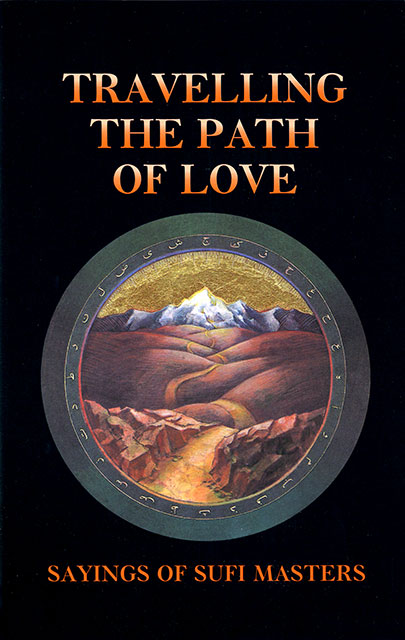
Excerpt from the Introduction
Sufism is truth without form.
~Ibn El-Jalali
Sufism is a mystical path of love. It emerged in the Muslim world in the eighth century in small groups of seekers who were known as "Wayfarers on the Mystical Path." In their deep passion and longing for God they realized Truth as "The Beloved," and therefore also became known as "The Lovers of God." Later they were called Sufis, possibly referring to their white woolen garments (Sûf), or as an indication of their purity of heart (Safâ). These small groups gathered around spiritual teachers and, in time, matured into fraternities and orders, with each order bearing the name of its initiator.
The essence of the Sufi path is the particular tradition passed down from teacher to disciple in an uninterrupted chain of transmission. Each Sufi order and teacher has certain practices and principles to help the wayfarer on the journey, to keep the fire of longing burning within the heart and the attention focused on the goal. The sayings and writings about the path help the wayfarer to develop the right attitude and qualities, and also to understand inner happenings that are often bewildering and confusing. The ways of love are very different from those of the mind.
The Sufi path has as its goal the state of union with God. For each traveller the journey to this goal is unique; it is the journey "of the alone to the Alone." Yet there are also stages which all seekers pass through, trials, processes of purification and transformation. It is these stages that the Sufi masters, or sheikhs, have attempted to describe. As guides they have mapped out the path of the heart and the mystical states that are experienced along the way.
The teachings and writings of the Sufis describe the soul's journey from separation to union with God. With the passion and depth of feeling that belong to lovers they outline the stages of this journey and give advice to other travellers. Sufi literature offers us the richest and most detailed understanding of the relationship of lover and Beloved, a relationship that is at the core of every mystical path.
Drawing on their own experiences, the Sufi masters describe the inner workings of the path of love. They tell how longing for God burns away our impurities. They remind us that by remembering God we come closer to our eternal essence and that in our moments of utmost despair the Beloved reveals Himself: He who had seemed so distant is discovered "closer to you than yourself to yourself." They share their glimpses of the essential oneness of all life and, with simplicity, directness, and humor, describe the paradoxical nature of this mystical journey.
The ninth-century ecstatic Bâyezîd Bistâmî, who left no writings, is known for his utterances made in a state of divine intoxication, like "Glory be to me. How great is my majesty!" Al-Junayd, who taught in Baghdad in the ninth century, advocated a path of sobriety and the integration of mysticism into ordinary life. At the same time in Baghdad the prince of lovers, al-Hallâj, spoke of the essential unity of lover and Beloved and was put to death for exclaiming the mystical truth "anâ'l-Haqq" ( I am the Absolute Truth). In the eleventh century in Nishapur the great master Abû Sa'îd ibn Abî-l-Khayr stressed the need to abandon the ego, or nafs, in order to realize the Pure Self.
These early mystics spoke a direct and simple language different from the more learned and scholarly writings of some of the later Sufis, as, for example, al-Ghazzâlî, who in the late eleventh century worked to reconcile the teachings of Islam, the "sharî'a", with the mystical path, the "tarîqa." A century later ibn 'Arabî, called "the greatest sheikh," and considered by many to be the greatest Muslim exponent of metaphysical doctrine, stressed the existence of One God and the Unity of Being (wahdat al-wujûd). A few years after ibn 'Arabî's death Jalâluddin Rûmî, spiritually awakened by his meeting with the wandering mystic Shams-i Tabrîz, began reciting one of the greatest mystical writings of all time, the Mathnawî, a treasure-house of spiritual lore.
Rûmî is the most widely read of the Sufi writers, and the contemporary translations of his work have made Sufism more known in the West. But he is only one of the many Sufis who, from the eighth century to the present day, have spoken and written about the path of love, of the pain and the bliss of the heart's opening to God. Each Sufi master is influenced by those who have gone before him, by the history of the tradition. But more important are the mystic's own experiences, his individual communion with the Beloved. This is the truth that speaks through their words, whether the direct utterances of the drunken Bâyezîd Bistâmî, or the metaphysical work of ibn 'Arabî.
Language and culture may change with time and place, but the inner workings of the heart remain the same. The essence of the mystical quest is beyond time and space, beyond all form. What the Sufi masters say about love speaks to all who long for their Real Home. They help to remind us of our divine nature and provide signposts on the way back to our innermost self. These lovers of God speak the direct language of spiritual experience, language that carries the conviction of those who have tasted Truth.
This selection of Sufi sayings is offered as inspiration for fellow-travellers on whatever path they may be following. The Sufi says that there are as many ways to God as there are human beings, "as many as the breaths of the children of God." Within each of us there is the call to "open your hidden eyes and come, return to the root of the root of your own self." This journey of the soul is mankind's most primal dream. It is the deepest purpose of life. On this journey we are in the company of all those who have gone before us. We are guided by their footprints.
– Llewellyn Vaughan-Lee, Edition
Excerpt from Chapter 4: The Longing of the Heart
The heart's longing for God is the pain of separation.
This primal cry of the soul draws the lover
back to the arms of the Beloved.
Listen to the reed how it tells a tale,
complaining of separations,
Saying, "Ever since I was parted from the reed-bed,
my lament has caused man and woman to moan.
It is only to a bosom torn by severance that I can unfold
the pain of love-desire.
Everyone who is left far from his source wishes back
the time when he was united with it."
The source of my grief and loneliness is deep
in my breast. This is a disease no doctor can cure.
Only union with the Friend can cure it.
– Râbi'a
I will cry to Thee and cry to Thee and cry to Thee
Until the milk of Thy kindness boils up.
– Rûmî
If the eight Paradises were opened in my hut, and the rule of both worlds were given in my hands, I would not give for them that single sigh which rises at morning-time from the depth of my soul in remembering my longing for Him.
– Bâyezîd Bistâmî
Oh Lord, nourish me not with love but with the desire for love.
– Ibn 'Arabî
Give me the pain of Love, the Pain of Love for Thee!
Not the joy of Love, just the Pain of Love,
And I will pay the price, any price you ask!
All myself I will offer for it, and the price you will ask on top of it!
Keep the joy for others, give me the Pain,
And gladly will I pay for the Pain of Love!
– Anonymous
Longing is a state of commotion in the heart hoping for meeting with the Beloved. The depth of longing is commensurate with the servant's love of God.
–al-Qushayrî
The world is full of beautiful things until an old man with a beard came into my life and set my heart a flame with longing and made it pregnant with love. How can I look at the loveliness around me, how can I see it, if it hides the face of my Lover?
– Persian song
A sweet smell has the dust at the feet of my Guru; never I cried before, but now there is no end of sorrow for me.
– Traditional
If God, when He created the world, had created no creatures in it; and if He had filled it full of millet from East to West and from earth to heaven; and if then He had created one bird and bidden it eat one grain of this millet every thousand years, and if, after that, He had created a man and kindled in his heart this mystic longing and had told him that he would never win to his goal until this bird left not a single millet-seed in the whole world, and that he would continue until then in this burning pain of love I have been thinking, it would still be a thing soon ended!
– Abû Sa'îd ibn Abî-l-Khayr
The inner truth of desire is that it is a restive motion in the heart in search of God.
– al-Qushayrî
There are those among you who desire this world and there are those among you who desire the world to come. But where is He who desires God?
– al-Shîblî
I am calling to you from afar;
Calling to you since the very beginning of days.
Calling to you across millennia,
For aeons of time–
Calling–calling.
Since always.
It is part of your being, my voice,
But it comes to you faintly and you only hear it sometimes;
"I don't know," you may say.
But somewhere you know.
"I can't hear," you say, "what is it and where?"
But somewhere you hear, and deep down you know.
For I am that in you which has been always;
I am that in you which will never end.
Even if you say, "Who is calling?"
Even if you think, "Who is that?"
Where will you run? Just tell me.
Can you run away from yourself?
For I am the Only One for you;
There is no other,
Your Promise, your Reward am I alone–
Your Punishment, your longing
And your Goal.
– Anonymous
Someone asked Râbi'a, "I have committed many sins;
if I turn in penitence towards God, will He turn in mercy towards me?"
"Nay," she replied, "but if He shall turn towards thee, thou wilt turn towards Him."
– Râbi'a
Until the beam of His love shines out to guide the soul,
It does not set out to behold the love of His Face.
My heart feels not the slightest attraction towards Him
Until an attraction comes from Him and works upon my heart.
Since I learnt that He longs for me, longing for Him never leaves me for an instant.
– Maghribî
If the magnet were not loving, how could it attract the iron with such longing?
And if love were not there, the straw would not seek the amber.
– Nizâmî
Not only the thirsty seek the water,
the water as well seeks the thirsty.
– Rûmî
Spiritual need is a living and luminous fire placed by God in the breasts of His servants that their "self" (nafs, or ego) may be burned; and when it has been burned this fire becomes the fire of "longing" (shawq) which never dies, neither in this world nor in the next.
– Abû Sa'îd ibn Abî-l-Khayr
One must have "spiritual need," for there is no shorter way to God for the devotee; if it passes through solid rock, water springs forth. "Spiritual need" is fundamental for the Sufis; it is the bestowal of God's mercy upon them.
– Abû Sa'îd ibn Abî-l-Khayr
You'll be free from the trap of your being,
when, through spiritual need,
You're trodden underfoot, like a mat,
in the mosque and the winehouse.
– Sanâ'î
Ecstasy is a flame which springs up in the secret heart, and appears out of longing.
– Paul Nwyia
Open your hidden eyes and return to the root of the root of your own self.
– Rûmî
When it is possible to hear the Beloved speak Himself, why listen to second-hand reports?
– Jâmî
Know that you are the veil which conceals yourself from you. Know also that you cannot reach God through yourself, but that you reach Him through Him. The reason is that when God vouchsafes the vision of reaching Him, He calls upon you to seek after Him and you do.
– al-Junayd
It is he who suffers his absence in me
Who through me cries out to himself.
Love's most strange, most holy mystery
We are intimate beyond belief.
– Rûmî
Biographical Notes from Chapter 4:
Abû Sa'îd ibn Abî-l-Khayr (d. 1049). An illustrious master-poet from Nishapur (originally from the town of Mayhana in Khurasan), who had a tremendous influence on the Sufis of his time.
Bâyezîd Bistâmî (d. 874). An ecstatic Sufi from Iran who has become known for his intoxicated exclamations uttered in the state of "oneness," e.g., "Glory be to me! How great is my majesty!"
Ibn 'Arabî, Muhyî-d-dîn Muhammad (d. 1240). One of the greatest figures in Sufi history; Andalusian by origin, he traveled in the West and the East and has become known in Sufi circles as ash-shaikh al-akbar (the Great Sheikh). He wrote extensively, giving a philosophical framework to his deep mystical insights. His best known work is Al-futûhât al-makiyya (Meccan Revelations). Also known for his exquisite love poetry.
Jâmî, Maulânâ 'Abdu'r-Rahmân (d. 1492). One of the most eminent Persian poets and writers from Herat (Afghanistan) affiliated with the Naqshbandiyya Order. His best known work, Nafahât al-'uns (The Breaths of Intimacy), traces the Naqshbandi tradition and lineage. Through his literary work he introduced ibn 'Arabî's theosophy into the Naqshbandi lore.
Junayd, Abû'l-Qâsim Muhammad al- (d. 910). The main Sufi teacher in Baghdad during the ninth century; many of the Sufis of his time clustered around him. He taught a type of mysticism which became known as "sobriety" (sahw) and was distinguished from the mysticism of "intoxication" (sukr) exemplified by Bistâmî and Hallâj.
Maghribî, Muhammad Tabrîzî (d. 1406). A Persian Sufi poet who had absorbed into his poetry the theosophical ideas of ibn 'Arabî on the "Oneness of Being" and "the Perfect Man," and who became instrumental in the distribution of these ideas.
Nizâmî, Ilyâs ibn Yûsuf (d. 1209). A Persian poet who preceded Rûmî in the tradition of Sufi love poetry.
Nwyia, Paul (d. 1985). A Jesuit scholar from Beirut known for his studies on the formative period of Sufism, as well as for his work on the Shâdhiliyya Order and on the Andalusian mystic ibn 'Abbâd of Ronda (d. 1390). Was killed in the civil war in Lebanon.
Qushayrî, Abû'l-Qâsim 'Abdu'l-Karîm al- (d. 1074). One of the great Sufi compilers of the eleventh century; an eminent figure in his hometown Nishapur. His compilation entitled al-Risâla fî 'ilm al-tasawwuf (The Epistle on the Knowledge of Sufism) has become the classic textbook for Sufi novices.
Râbi'a al-'Adawiyya (d. 801). A female Sufi from Basra famous for her devotional love for God and for her intoxicating love poetry. A large part of the introduction of the theme of Divine love into Islamic mysticism is attributed to her.
Rûmî, Maulânâ Jalâluddîn (d. 1273). A most illustrious Sufi poet in the Persian language, from Konya (in modern Turkey), his Mathnawî as well as his Dîwân-i Shams-i Tabrîz have become inspirations to countless devotees of "the Religion of Love." His mystical love poetry was inspired by the spirit of his master Shamsuddîn Tabrîzî. He founded the Mevleviyya Order known as The Whirling Dervishes.
Sanâ'î, Abû'l-Majd Majdûd (d. 1131). A forerunner of Rûmî, from Ghazna (Afghanistan); one of the founders of Persian love poetry.
Shiblî, Abû Bakr ibn Jahdar al- (d. 945). An ecstatic Sufi from Baghdad, a disciple of Junayd and an associate of Hallâj; became known as a mystic whose intoxication resulted in "holy" madness; due to his madness he was spared of being accused of heresy and of the gallows.
Acknowledgments:
For permission to use copyrighted material, the Editor gratefully wishes to acknowledge: Daniel Liebert, for permission to quote from Rumi: Fragments, Ecstasies, translated by Daniel Liebert; Khaniqahi-Nimatullahi Publications, for permission to quote from Sufi Symbolism, Volume One, Volume Two, and Volume Six, by Dr. Javad Nurbakhsh; Maypop Books, for permission to quote from We are Three translated by Coleman Barks; Mazda Publishers, for permission to quote from The Secrets of God's Mystical Oneness by Mohammad Ebn-e Monavvar, translated by John O'Kane: Meeramma Publications, for permission to quote from Love's Fire by Andrew Harvey; Mizan Press, for permission to quote from Principles of Sufism by al-Qushayri; Omega Press, for permission to quote from The Hand of Poetry; Pir Publications, for permission to quote from Atom from the Sun of Knowledge by Lex Hixon; SUNY Press, for permission to quote from The Sufi Path of Love by William Chittick; The Post-Apollo Press, for permission to quote from Rumi and Sufism by Eva de Vitray-Meyerovitch; Threshold Books, for permission to quote from Open Secret and The Doorkeeper of the Heart translated by Kabir Helminski; University of North Carolina Press, for permission to quote from Mystical Dimensions of Islam by Annemarie Schimmel, © 1978; Unwin Hyman Ltd., for permission to reproduce an extract taken from Rumi Poet and Mystic by R.A. Nicholson.